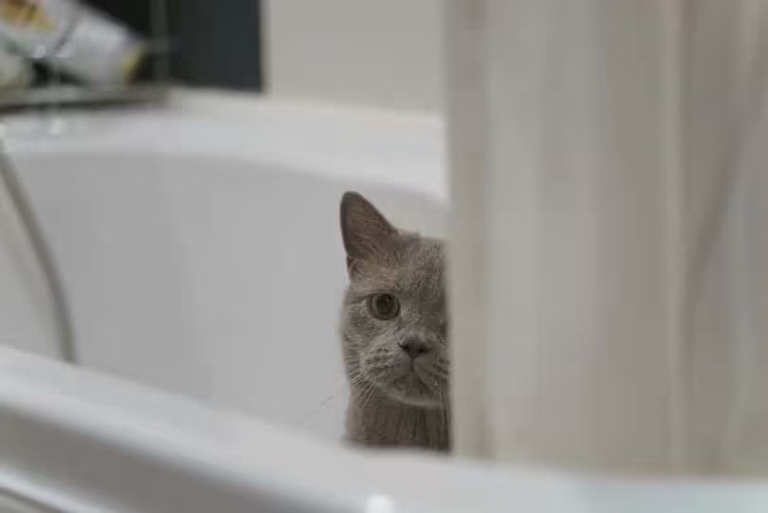


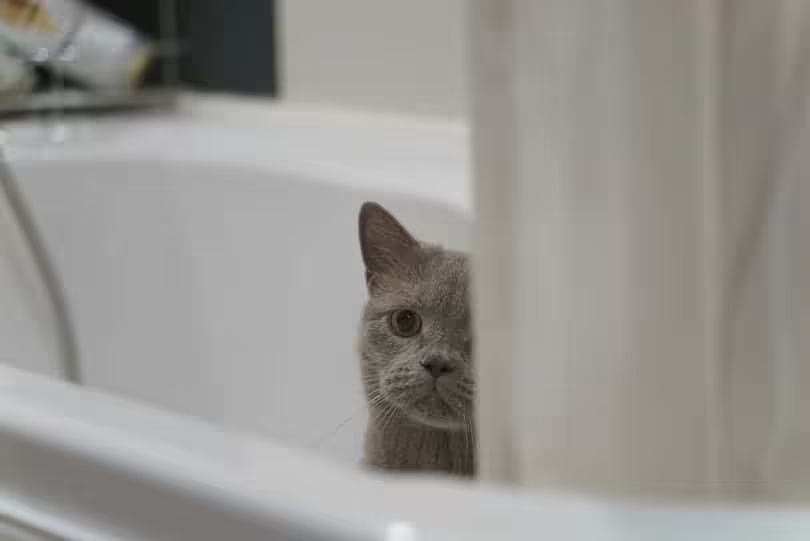
Your cat is observing you shower because he’s curious about the running water, it is a way to find you, or he has learned that you shower in the morning. This is a normal habit and not necessarily problematic.
Cats also see things you don’t see, like each drip, every shadow in motion, and the warmth of the steam. This is a normal habit and is not necessarily harmful. If you know more about your cat’s behavior, consult an expert now.
Why Does My Cat Watch Me Shower?
There are three main reasons why your cat watches you shower. It just wants to know what’s happening with that running water, it wants to be close to you, or it wants you to pay attention to it. One rarely causes it all, and the combination varies from day to day.
Use body language to get clues. A cat sitting quietly, with relaxed eyes, is probably just keeping you company, and a cat pawing at the curtain is probably playing with the water. A loud meow means a cat is demanding attention.
See what happens before and after your shower as well. If your cat gets up at the same time each day, or approaches the food bowl when you go out, you are telling him what to expect.
9 Reasons Why Your Cat Watches You in the Shower
1. Your Cat Is Naturally Curious About What You Are Doing
Anything new and different is for cats to investigate, and a shower provides lots to find out as water is running, steam is rising, and the curtain is moving. Their senses are also well developed. They can turn their ears around 180 degrees and hear a much broader range of sounds than you.
2. Your Cat Wants to Stay Close to You
Cats can form true relationships with humans. Oregon State University researchers observed cats during a study in which the owner left the room and re-entered and determined that some 65 percent of kittens and adult cats were securely attached. Human babies are nearly alike.
Your cat might just be seeking attention, as it can comfort the animal during a stressful time. A desire to be accompanied is not separation anxiety, in which one feels distressed when separated.
3. Your Shower Routine Has Become Part of Your Cat’s Routine
Cats notice routines quickly, so if you shower at the same time daily, your cat will quickly pick up on the pattern. According to a University of Illinois study, cats are most active 2 hours prior to feeding. That chain might include your shower, and that can account for your cat arriving at the door to the bathroom just in time.
4. Your Cat Is Interested in Running Water
Many cats are drawn to running water, likely because moving water signals a fresher, safer drinking source in nature and its rapid, shifting movement mimics prey and stimulates play.
Still, watching water does not mean your cat wants to get wet. Most cats dislike wet fur, which feels uncomfortable and makes movement harder.
5. Your Cat Is Waiting for Your Attention
Cats know how to get your attention. Feline behavior researchers have found that cats are much more likely to approach and initiate contact when their owner is stationary, such as standing in an enclosed shower rather than moving unpredictably around the home.
Your response is important, too. When you speak to your cat or pet it, you are rewarding the behavior, and cats repeat behaviors they are rewarded for.
6. Your Cat Feels Safe When You Are Nearby
Cats seek comfort from trusted individuals, and keeping you within their line of sight helps them feel calm and secure in their territory. This calm visual monitoring is distinct from separation anxiety, where a cat becomes panicked when left alone, a condition that warrants veterinary evaluation.
7. Your Cat Is Fascinated by the Shower Curtain or Glass
Cat eyes are designed to pick up on rapid movement. A fluttering curtain, a shadow, or a swinging droplet on the glass can attract your cat’s attention. It is also possible that these sights trigger play or hunting behavior, so some cats paw at the curtain. It’s not a problem, it’s play.
8. Your Cat Is Waiting for You to Finish Showering
Cats excel at associative learning, so if breakfast, play, or cuddles consistently occur right after you finish showering, your cat learns this sequence. The sound of the water turning off serves as a conditioned cue that a reward is coming, meaning your cat is eagerly waiting for what happens after the shower rather than focusing on the shower itself.
9. Your Cat Enjoys the Warmth and Humidity
Cats prefer an ambient thermoneutral zone of 86–100°F (30–38°C), which is much warmer than typical household room temperatures. Because a normal cat’s core body temperature is 100.5–102.5°F (38.1–39.2°C), a room that feels comfortably mild to you can feel chilly to your cat, making a warm bathroom very appealing. Gentle ambient warmth can also help soothe joint stiffness in cats with osteoarthritis, though individual cats vary in how much they enjoy warm, steamy environments.
Why Does My Cat Sit Outside the Shower and Stare at Me?
Most cats don’t like getting wet and prefer to stay outside the shower stall where it is dry, watching you from a safe distance. Closed doors will also attract cats, making your bathroom even more intriguing when you’re inside. If it’s a cat that is calm, it is probably just inquisitive and not scared.
Why Does My Cat Meow or Cry While I Shower?
If your cat meows, it means that there is something it wants. It may want attention, or it may feel frustrated because the door is closed, preventing it from getting to you. A play session before your shower can help, as cat experts say they are most frequently meowing when they are not getting what they need, and this includes needing to play and spend time with you.
It is normal for a cat to meow occasionally, but veterinarians recommend a veterinary exam if the cat meows now or the frequency is increasing.
Does My Cat Think I’m Drowning When I Shower?
Though some cats rush to the rescue to keep you from drowning, there is no scientific evidence for that. Cats most likely don’t realize what you are doing inside.
Your cat will likely focus on the water noise, movement, and steam. Some cats make noises when they hear an odd noise or when they cannot reach you. But what the research does reveal is that most cats respond to their owners by seeking comfort, rather than rescue, which is more consistent with simple companionship. Use the protective theory as a game of guess and check, rather than a true statement.
Is It Normal for My Cat to Watch Me Shower?
Yes, this is a normal feline behavior, and most is due to curiosity, companionship, and routine. If a cat watches quietly and then goes back to normal life, it doesn’t give you any reason for concern.
However, keep an eye out for changes! If your cat all of a sudden starts or stops following you, a veterinarian advises you to seek out what’s going on. Your veterinarian will be able to determine if it is a medical or behavioral problem.
Should I Let My Cat Watch Me Shower?
Yes, as long as your cat is safe. Keep it in a place where water can’t splash it, keep hot water off it, and ensure it can’t slip in the tub or get caught.
Keep shampoos, soap, Vaseline, ointments, and cleaners out of the way, as some cleaners may burn or irritate the cat’s mouth and stomach. Cats also ingest bits of the spill when cleaning up afterwards, so never let your cat drink soapy shower water. Cats are significantly more sensitive to essential oils than dogs because their livers lack specific enzymes required to break down these compounds, and the oil may fall onto fur and be ingested when they groom. When your cat eats something, you should call your veterinarian or ASPCA Animal Poison Control Center at (888) 426-4435.
How to Stop Your Cat From Following You Into the Shower
First, make sure to satisfy your cat’s needs. Experts say play time should be at least twice per day. Put a puzzle feeder inside before you shower, and have a cosy bed or perch, preferably a tall perch or cat tree, outside of the bathroom. Praise quiet and still behavior.
Do not shout at or spray your cat with water, as experts state that punishment increases a cat’s fear and damages the relationship. Have the same bathroom routine each day, as cats get more and more educated when they know what to expect.
When Should You Worry About Your Cat’s Bathroom Behavior?
It’s not a sign of sickness to watch you shower, but a sudden change is another. If your cat’s behavior is new, is worse, or is becoming worse, talk to your veterinarian, such as increased crying, unusual clinging or hiding, appetite changes, overgrooming, aggression, and/or litter box changes. Your veterinarian will be able to exclude medical causes first.
Senior cats have a special need for additional care. Nearly 10 percent of cats older than 10 years have hyperthyroidism, which can manifest itself in increased meowing and restlessness, while about 28 percent of cats 11 to 14 years of age exhibit some degree of brain aging. In a particular study of 223 cats, approximately 13% exhibited at least one symptom of separation-related issues.
Frequently Asked Questions
Why does my cat stare at me through the shower glass?
Cat eyes are built to catch fast movement. Droplets, steam, and your motion all give your cat something to follow.
Why does my cat wait outside the bathroom while I shower?
Routine, companionship, and curiosity all play a part. Your cat may also expect food, play, or cuddles when you finish.
Why does my cat come into the shower after I finish?
The warm, steamy room may feel good to your cat, and leftover droplets can act like toys. Keep soapy surfaces off limits.
Why does my cat watch me shower but hate getting wet?
Watching water costs your cat nothing, but wet fur feels uncomfortable. Cats can enjoy looking at water while disliking its touch.
Why does my cat lick me after I shower?
Skin holds salt and sugar from sweat, and some cats like the scent of lotion or shampoo. Licking can also show affection, but never let your cat lick lotions.
Why does my cat follow me everywhere, including the shower?
Bonding, routine, and rewarded attention explain it. Most cats are securely attached to their owners and use them for comfort.